What Is KNX? A Buyer's Guide for Malaysian Buildings
The open standard explained in plain words, compared honestly with the alternatives, and the questions that make any two quotations comparable.
Our Specialism
We Specialise in KNX Projects Under RM100,000
Nobody in Malaysia has delivered more. 388 of our 524 systems were contracted below RM100,000, in homes, offices, factories and campuses, with the same topology discipline, documentation and witnessed handover as our largest jobs.
- Projects Under RM100k
- 388
- Share of Our Record
- 74%
- Median Contract
- RM38,400
- Complete Systems From
- RM15,000
- Residential RM24,600 Double-storey terrace, whole home, Setia Alam
- Commercial RM58,300 Shoplot café, trading through the install, George Town
- Industrial RM78,500 22-aisle warehouse zoning, Port Klang
- Higher Education RM62,800 Two 300-seat lecture theatres, Bangi
What Is KNX?
KNX is the open international standard for building automation: one two-core bus cable connects lighting, air-conditioning, blinds, sensors, metering and security devices from more than 500 manufacturers, so they work together as one system without depending on any single brand, server or cloud.
It is used in homes, office towers, hotels, factories, warehouses and university campuses, and it is the reason a building wired in 2014 can still be maintained, extended and re-programmed by a different engineer today. In Malaysia it is specified where a building has to outlive its first owner: developer rollouts, Grade-A offices, plant and campus estates.

- Standard
- ISO/IEC 14543-3, EN 50090 and CENELEC; GB/T 20965 in China
- Owner of the standard
- KNX Association, Brussels, founded 1999 from the EIB, BatiBUS and EHS standards
- Wiring
- A two-core twisted-pair bus cable at 30 V DC, laid in parallel with power cables
- Line size
- Up to 64 devices per line, 15 lines per area and 15 areas per installation
- Manufacturers
- 500+ certified manufacturers whose devices work together on one bus
- Engineering tool
- ETS (Engineering Tool Software), the one tool every KNX device is programmed in
How Does a KNX System Work?
Four parts, and none of them is a single point of failure. Intelligence is spread across the devices on the bus, so a failed touch panel or app server never takes the lights down with it.
- 1
The Bus
One green two-core cable runs to every keypad, sensor and actuator. It carries power for the devices and the messages between them, so there is no central computer to fail.
- 2
Sensors and Actuators
Keypads, presence sensors and weather stations send telegrams. Switch, dimming, blind, valve and DALI actuators in the distribution board act on them.
- 3
ETS Programming
Each device is given a physical address and linked to group addresses in ETS. That project file is the system: whoever holds it can maintain or extend it.
- 4
Gateways
IP, BACnet, Modbus and DALI gateways connect the bus to the BMS, meters, air-conditioning and the touch panels and apps people actually use.
KNX Compared with Smart Switches, Proprietary Systems and BMS
Each has a place. The question is who can look after the building in year ten, and what still works when the internet does not.
| What Matters | KNX | Wi-Fi or Zigbee Smart Switches | Single-Brand Proprietary System | Conventional BMS |
|---|---|---|---|---|
| Who Can Maintain It Later | Any certified integrator with the ETS file | The homeowner, until the app is discontinued | Only that brand's dealers | The original BMS vendor, usually |
| Brands You Can Mix | 500+ manufacturers | One ecosystem at a time | One brand | Mostly one vendor per controller |
| Works with the Internet Down | Yes, logic runs on the bus | Often not, many rely on a cloud | Usually, on the local controller | Yes |
| Typical Lifespan | 20 years and more | 3 to 7 years | 10 to 15 years | 15 to 20 years |
| Wiring | Dedicated bus cable | None, radio only | Dedicated, brand-specific | Dedicated field cabling |
| Room-Level Lighting, Blinds and Air-Conditioning | Native | Basic, per device | Native | Weak, built for plant |
| Energy Metering and MS 1525 Evidence | Yes, via meters and gateways | Rarely | Sometimes | Yes, plant focused |
| Best Fit | Any building expected to outlive its first owner | A rented room or short-term fix | A single home, one dealer for life | Chillers, AHUs and central plant |
KNX and a BMS are not rivals: on most commercial and campus jobs KNX runs the rooms and hands energy and alarm data to the BMS over BACnet or Modbus. See Integrations.
What KNX Does in Each Kind of Building
 Residential · 130 projectsHomes and developersScenes per room, air-conditioning and blinds on one keypad, and a template repeated across every unit of a development so the JMB inherits one documented system.Explore Residential
 Commercial · 135 projectsOffices, hotels and retailCAT-A zoning that CAT-B fit-outs re-address in ETS without rewiring, hotel guest-room control, and tenant sub-metering for MS 1525 and GBI.Explore Commercial
 Industrial · 95 projectsFactories and warehousesHigh-bay aisle zoning, maximum-demand load shedding against the TNB tariff, Modbus metering and alarm escalation that keeps running through a shift change.Explore Industrial
 Higher Education · 90 projectsUniversities and campusesLecture theatre scenes, timetable-driven hostel air-conditioning, per-faculty energy metering and retrofits programmed inside semester breaks.Explore Higher Education
Eight Questions to Ask Any KNX Integrator Before You Sign
They take ten minutes and make any two quotations comparable. We answer all eight in writing on every proposal, including the ones under RM100,000.
- 1
Ask for a Points List
Every switched, dimmed, motorised and metered circuit, counted. Two quotations without points lists cannot be compared.
- 2
Ask Who Keeps the ETS Project File
It must be handed to you, unlocked, with the project password. Without it no one else can maintain the system.
- 3
Ask for the Topology
Lines, couplers and power supplies with spare capacity stated. A line loaded to 64 of 64 devices has no room to grow.
- 4
Ask How It Is Tested
Per-circuit witnessed testing against the points list, signed off by your representative, not a demo of three scenes.
- 5
Ask What Happens Offline
Which functions still work with the internet, the app server and the touch panel all switched off. The answer should be: all of them.
- 6
Ask About Brands and Spares
Which manufacturers are used and whether an equivalent device from another brand can replace a failed one.
- 7
Ask What You Receive at Handover
As-built drawings, panel schedules, group-address list, user guide and a trained person on your side.
- 8
Ask Who Programs It
Whether design and ETS programming are done in-house or subcontracted, and who answers the phone in year five.
KNX Glossary
The ten terms that appear in every KNX proposal, drawing and handover pack.
- Group address
- The shared "channel" a keypad and an actuator are both linked to in ETS. Pressing the key sends a telegram to that address and every device listening acts on it.
- Physical address
- The unique address of one device on the bus, written as area.line.device, for example 1.1.12.
- Line coupler
- A device that joins a line to the main line, filtering traffic so each line only carries the telegrams it needs.
- KNX power supply
- The unit that powers the bus at 30 V DC through a choke. Each line needs its own, sized with headroom.
- Actuator
- A device, usually DIN-rail mounted in the distribution board, that switches, dims or drives a load such as a light circuit, blind motor or valve.
- Telegram
- A short message on the bus carrying a group address and a value, such as "on", "dim to 40%" or "21.5 °C".
- ETS
- Engineering Tool Software from KNX Association, used to design, program, diagnose and document every KNX installation.
- KNX IP
- KNX carried over Ethernet, used as a fast backbone between floors or blocks and for visualisation and integration.
- DALI
- Digital Addressable Lighting Interface. A KNX-DALI gateway lets the bus address up to 64 individual light fittings per DALI line.
- Orphaned system
- A KNX installation whose original integrator has gone and left no ETS file. It can usually be recovered, but takes longer than it should.
Questions We Are Asked About This
What is the difference between KNX and Loxone / Control4 / Crestron?
Should I just buy Wi-Fi smart switches instead of KNX for my house?
What happens if the internet goes down - will lights stop working?
Can I really mix different brands (e.g. ABB switch + Hager actuator)?
Can I expand the system later, or am I locked in?
What if a KNX device fails after 5 years - can I still get parts?
How much does a KNX system cost in Malaysia?
Book a Design Review
Send the drawings, the problem, or just the building type. Peter replies with the right next step: a design-stage review, a site survey, a diagnostic call-out or a scoped quotation. Response within one working day.
Talk to the Engineer Directly
Peter Teh (Teh Hon Kee)
Lead KNX Integrator
Phone / WhatsApp
+6016-531 3713Based in
Kuala Lumpur · serving all Malaysia
Hours
Mon-Fri 9:00-18:00 · Sat 10:00-15:00
24/7 emergency cover on Gold contracts
Send Your Enquiry
Free Consultation
No-obligation site visit & quote within the Klang Valley.
Quick Response
We typically respond within 2-4 hours in business hours.
Detailed Quote
Itemised quotation with device specs within 3-5 days.
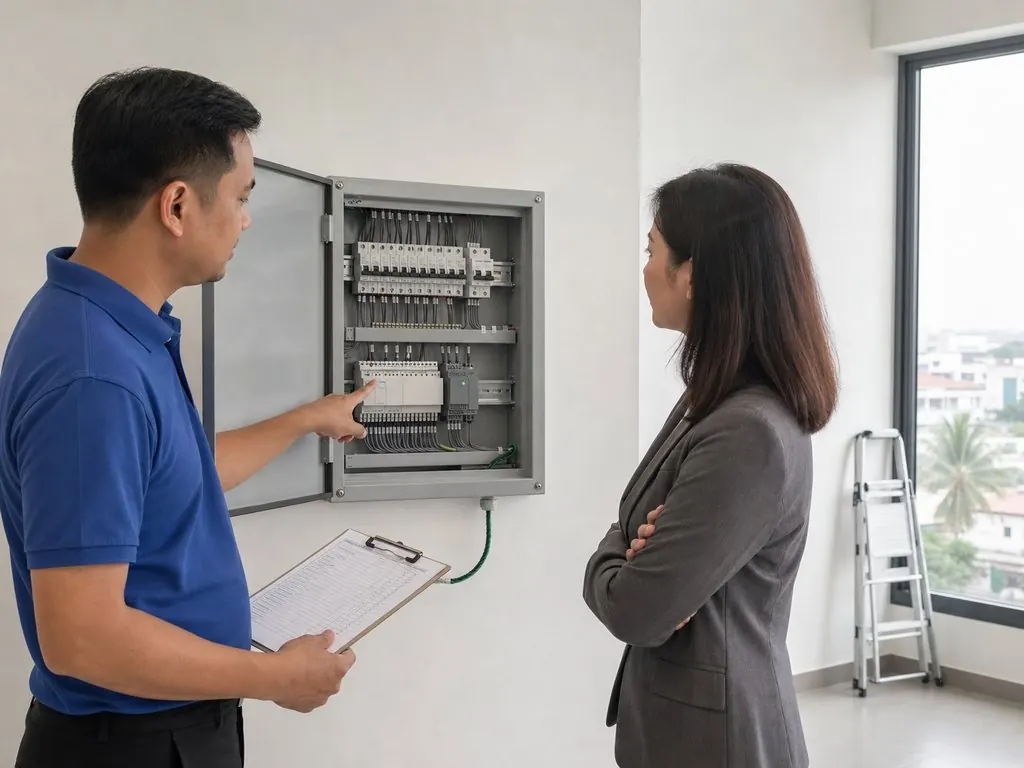
A design review costs you nothing and usually saves a redesign.
Bring drawings, a photo of the panel, or just the building type.